Keeping what you read is old and simple: copy out the passages that matter, put them under a
heading, and come back to them. The question has always been where to put them so you can find
them again. For a long time the answer was a book. For the readers who wrote the most, it ended
up being a box of cards.
The commonplace book
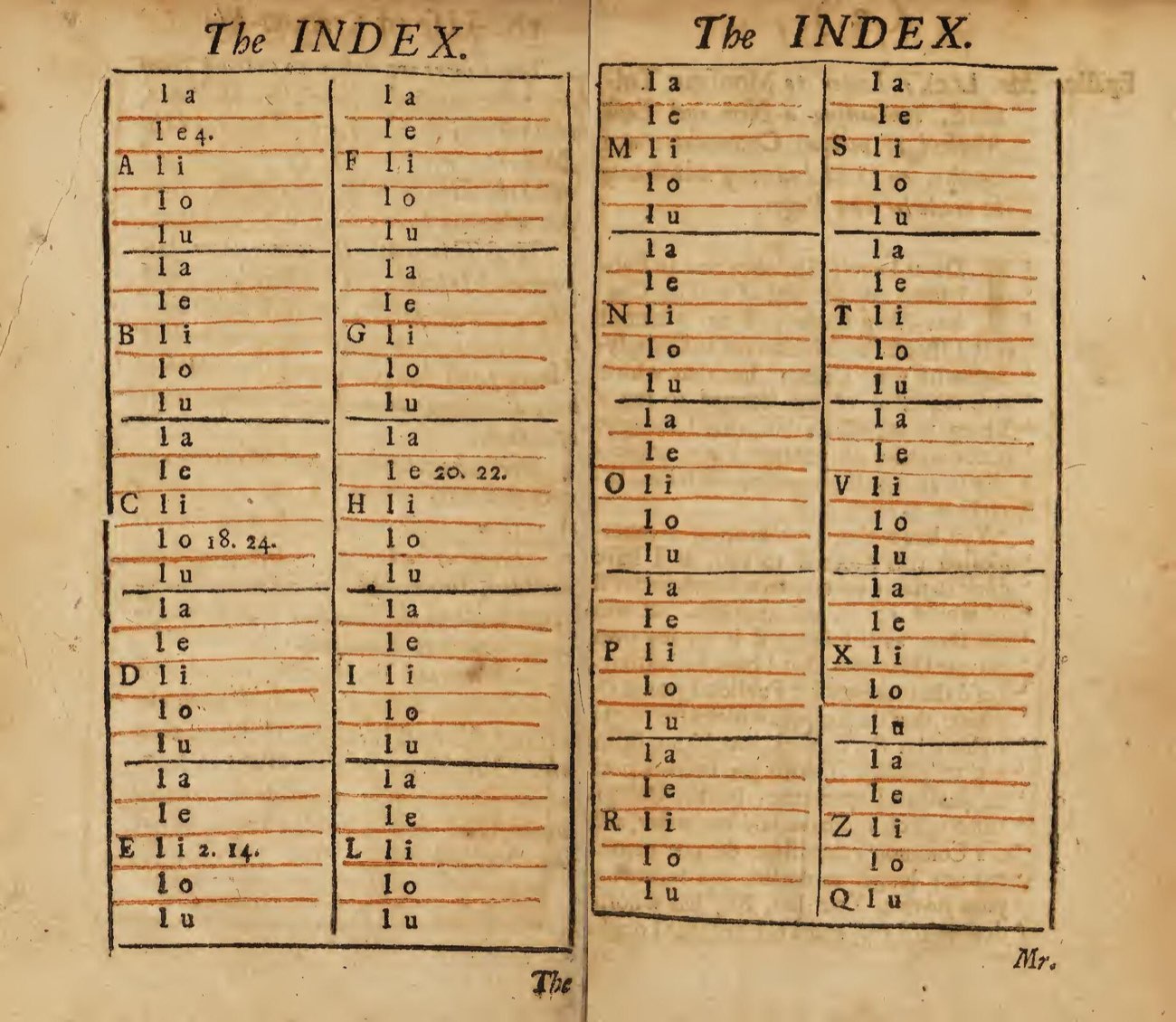
A commonplace book is a notebook of passages gathered under headings: Justice, Friendship, Death. John Locke kept them for decades and published his method
for indexing one, in French in 1686 and in English in 1706, two years after his death. The whole
index fits on two pages. Each heading is filed by its first letter and the first vowel after it,
and the index line gets the page number where that heading begins.
The index from Locke’s A New Method of Making Common-Place-Books, London, 1706.
Each row is a first letter and a vowel; page numbers are filled in as headings are started. Public domain; scan by the Wellcome Collection, via Wikimedia Commons.
Where a book falls short
It is a good method, and a bound book still works against it:
Nothing can move. Once a passage is written on page 52, it lives on page
52. You can’t slide it next to the passage it argues with.
You guess how much room each idea needs. Leave two pages for Justice and it fills up; the rest goes wherever the next blank page is, with a note saying
“continued on p. 140”.
Books fill up. A second volume starts, then a third, and every idea is
split across all of them.
Order follows time, not thought. Passages land in the order you read them.
To see everything on one idea you chase page numbers through the index, every time.
None of this matters for a few months of reading. Over years, it is why so many commonplace
books end up beautiful and unused.
The card file
Cards fix the book’s problem by giving up the binding. Each passage gets its own card, and a
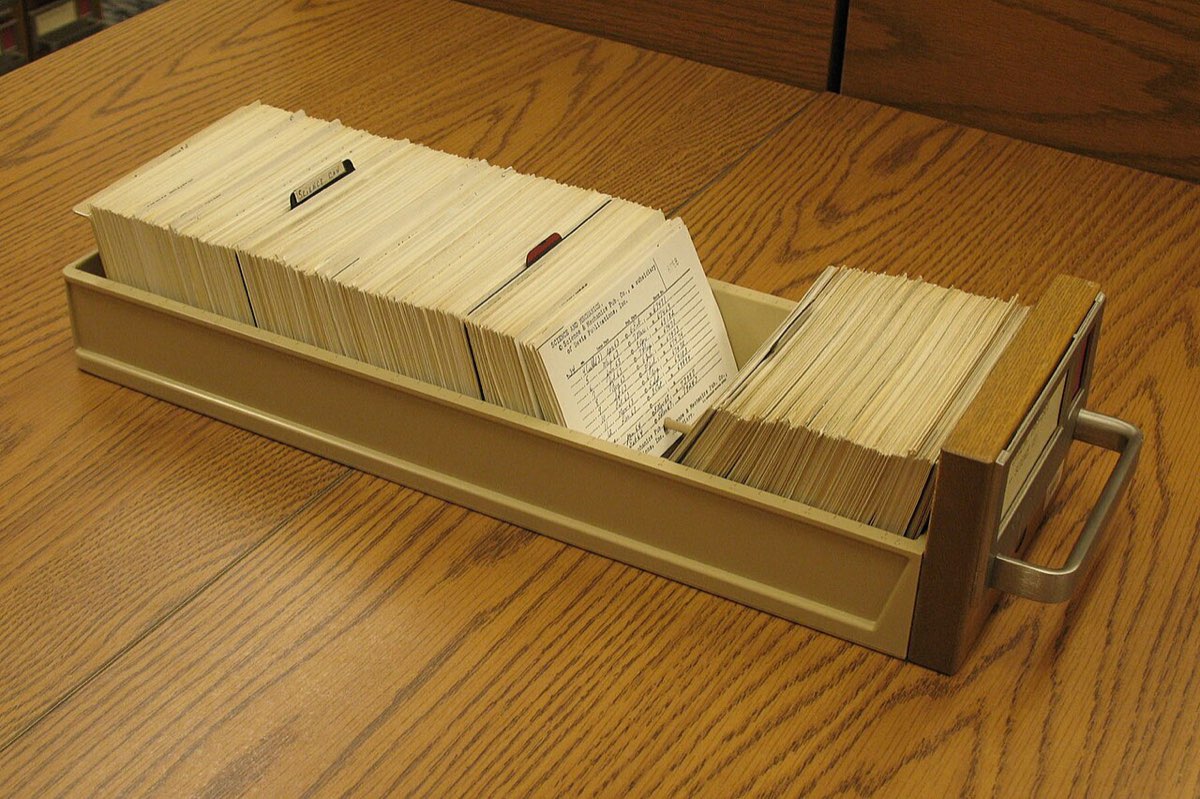
card can go anywhere. Libraries ran their catalogues this way for a century, a drawer of cards
with tabbed guides standing between the runs. Niklas Luhmann wrote some ninety thousand cards
into two slip boxes over forty years. Umberto Eco told his students to keep reading cards.
A drawer from the copyright card catalogue at the Library of Congress, with tabbed guides
between the runs of cards. Photograph by Michael Holley, public domain, via Wikimedia Commons.
The grandest card file of all was built in the 1940s. Mortimer Adler and a team of indexers read
through the Great Books and filed every important passage under one of 102 Great Ideas, from 1 Angel to 102 World. The result, the Syntopicon, was published in 1952. The photographs of its card files show the idea of this whole
project: rows of cards behind numbered tabs, 46 Law, 50 Love, 86 Sin, so that everything said about
one idea, by every author, sits in one place.
Why cards work
One idea to a card. Each card stands alone, so it can be moved, copied
out, or laid on the table beside another.
Filed by idea, not by book. A passage from Plato and one from Hobbes
end up next to each other, behind Justice, where you can read them together.
There is always room. A new card slips in exactly where it belongs. The
box grows; it never fills up a volume.
A number is an address. Card № 0412 can be refiled,
but its number never changes, so other cards can point to it.
And where the app comes in
A box has limits too. A card can only stand in one place, though it may belong to three ideas.
Finding a passage you half remember from six years ago means opening every drawer it might be
in. And a flood, a fire or a move can take the whole thing. Those are the only jobs for the
Commonplace Box app: to find any card from its words, to show one card under every idea it
belongs to, and to keep a copy safe. The paper stays the original. The app is just the index,
which is all Locke’s two pages ever were.